Come as you are! Everyone welcome … In-person or on Zoom.
R E A D I N G S
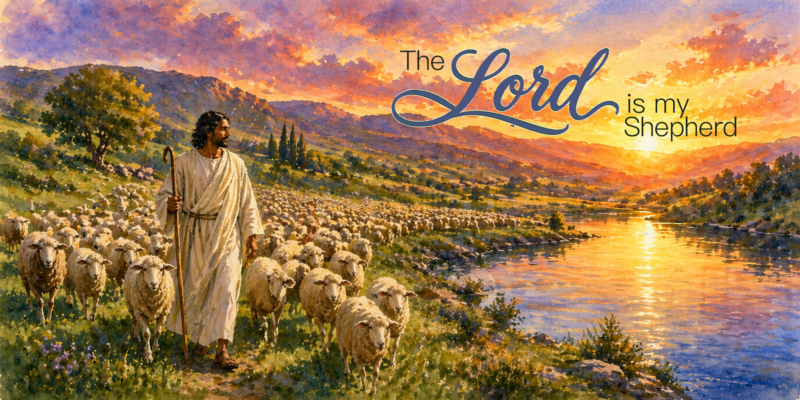
🔆Psalm 23 🔆1 Peter 2:19-25 🔆1 John 10:1-10
S E R M O N
🔆“The Power & Weakness of the Sacrificial Shepherd” – The Rev. Dr. Max Lynn
M U S I C
PRELUDE … Prelude on RESIGNATION, Zachary Wadsworth (b. 1983)
INTROIT … Uyai Mose (Come and Worship Lord God), Zimbabwe
HYMN … My Shepherd Will Supply My Need
ANTHEM … The Song of the Tree of Life, Ralph Vaughan Williams (1872-1958)
HYMN … Come, Thou Fount of Every Blessing
OFFERTORY … Basse et dessus de Trompette, Louis Nicolas Clérambault (1676-1749)
HYMN … Savior, Like a Shepherd Lead Us
POSTLUDE … Christ ist Erstanden, verse 1, Johann Sebastian Bach (1685-1750)
Join us for Coffee Hour immediately after the service.
To subscribe to the weekly newsletter, click here.
To join the Zoom weekly Service, click here.

Upcoming St. John’s Sunday Forum
Take a break after worship for 5-10 minutes, then come back for a conversation:
May 3 –Join Pastor Max, Rabbi Jonathan Seidel and Bob Jaffe in a discussion of the Holy Land, Zionism. the formation of the State of Israel and aspirational visions vs “Messianic” views in Jewish and Christian thought and Scriptural reception. Our conversation will touch on new developments in Israel in recent years that are disturbing and challenging for Interfaith and politically progressive Justice work and collaboration.
May 31 –AI & Humans. How Will We Relate? Spend an hour with Dr. Braden Molhoek, Director, Center for Theology and the Natural Sciences (CTNS), and Ian G. Barbour, Assistant Professor of Theology, Science, Ethics, and Technology at the Graduate Theological Union.
AI is changing our relationships (including humanity’s relationship with God and with the rest of creation). How we think theologically about AI inspires new questions of ethics, virtue, and creation. For example, is AI made in the image of God or of humans? What would its designers say? What do we say? What implications does the answer to this question have for our future and our relationship to AI? Come learn more in an engaging and timely Education session.
Piano Restoration & Workshop Visit
Currently, our cherished Bösendorfer piano is in the shop. As it happens, the beautiful loaner we are using is also a Bösendorfer; we have been fortunate. Callahan Piano Service, which has taken care of St. John’s pianos for decades, is restoring our instrument. This is necessary every three or four decades. The felts compress, the strings begin to break, accidents leave marks and gouges on the case, and it is necessary to have extensive work done to bring a piano back up to its potential.
John Callahan himself has invited SJ members and friends to tour his workshop in Alameda to see pianos being refurbished, including ours. On Saturday, May 23 at 10am, we will have the opportunity to visit and ask questions. Please let Todd Jolly know if you are interested in joining the group, and if you would like a ride. The Callahan piano workshop address is 1800 Ferry Point, Building 14, Suite 100, Alameda, CA 94501. Detailed driving directions are available at callahanpiano.com/contact
Sunday School Youth Mission Trip – all are welcome
Join us for a half a day of service, fellowship and faith in action as we reach out to our community on Sunday, May 31. We are visiting Greater Richmond Interfaith Program (GRIP) to help prepare and serve lunch. GRIP’s mission is to support families on their journey to self-sufficiency; They provide safe shelter, meals, case management, and long-term resources at no cost to those in need.
We are departing from St. John’s at 8:30am and expected to return around 2pm. If you would like to participate with us, please contact Manju Noone for more details at manju@stjohnsberkeley.org.
QR Code for Giving Money to St. John’s
One can now donate via PayPal for weekly giving and special events. Simply scan the PayPal QR Code in our bulletin or church lobby. All donations are tax-deductible. Thank you for your continued support.
The church cannot be silent – but what should it say?
By Harriet Riley, Presbyterian Outlook Magazine
“The church cannot be silent.”
In a recent lecture at Montreat Conference Center, William Yoo, an author, church historian and professor, described the church as “the moral guardian of community,” and he explored the tension between faith and patriotism while urging Christians to speak out against White Christian nationalism.
During his talk, which was titled “The Church Cannot Be Silent, But What Should It Say?” Yoo drew on the work of sociologist Andrew Whitehead, who defines Christian nationalism as a political orientation draped in religious rhetoric that asserts civic life should be organized around conservative Christianity that idealizes the White, natural-born citizen. Grounding his argument in both history and theology, Yoo referenced the address that Martin Luther King Jr. gave at Montreat, noting that King insisted “the church must speak to the power structure of the nation,” while also affirming that he “still had faith in America.”
Even as he urged the church to have a stronger voice, Yoo cautioned against “political hobbyism,” a term coined by political scientist Eitan Hersh. On the website Boston 50 Review, Hersh describes political hobbyism as “consuming and participating in politics by obsessive news-following and online ‘slacktivism,’ by feeling the need to offer a hot take for each daily political flare-up, by emoting and arguing and debating, almost all of this from behind screens or with earphones on.”
“Most of us are engaging with politics to satisfy our own emotional needs and intellectual curiosities. That’s political hobbyism,” Hersh wrote.
Yoo also warned against reactive political engagement. “We should not let our discernment be ruled by the social incident of the day,” he said, and he called for congregations to do the harder work of thinking about politics as a matter of morality. “The Bible offers clear principles, but not specific policies,” Yoo said. “Churches should think about political solutions that celebrate the dignity of all humans.”
In a follow-up interview, Yoo, who has written several books on church history, African American Christianity and more, expanded on what it means for the church to act as a moral guardian. “The church as moral guardian can interpret policies based on biblical principles, allowing for humility and discernment,” Yoo said. “Christians should have faithful dialogue.”
For Presbyterians, Yoo suggested, this kind of faithful dialogue is both necessary and possible, given the denomination’s political diversity. “Many of our churches are ideologically diverse, which does lead to some tension. But if we can show how to mutually discern the call of God in our lives and in our nation, that would be a positive and powerful witness.”
To continue reading this article, please click on the link for the Presbyterian Outlook Magazine website.